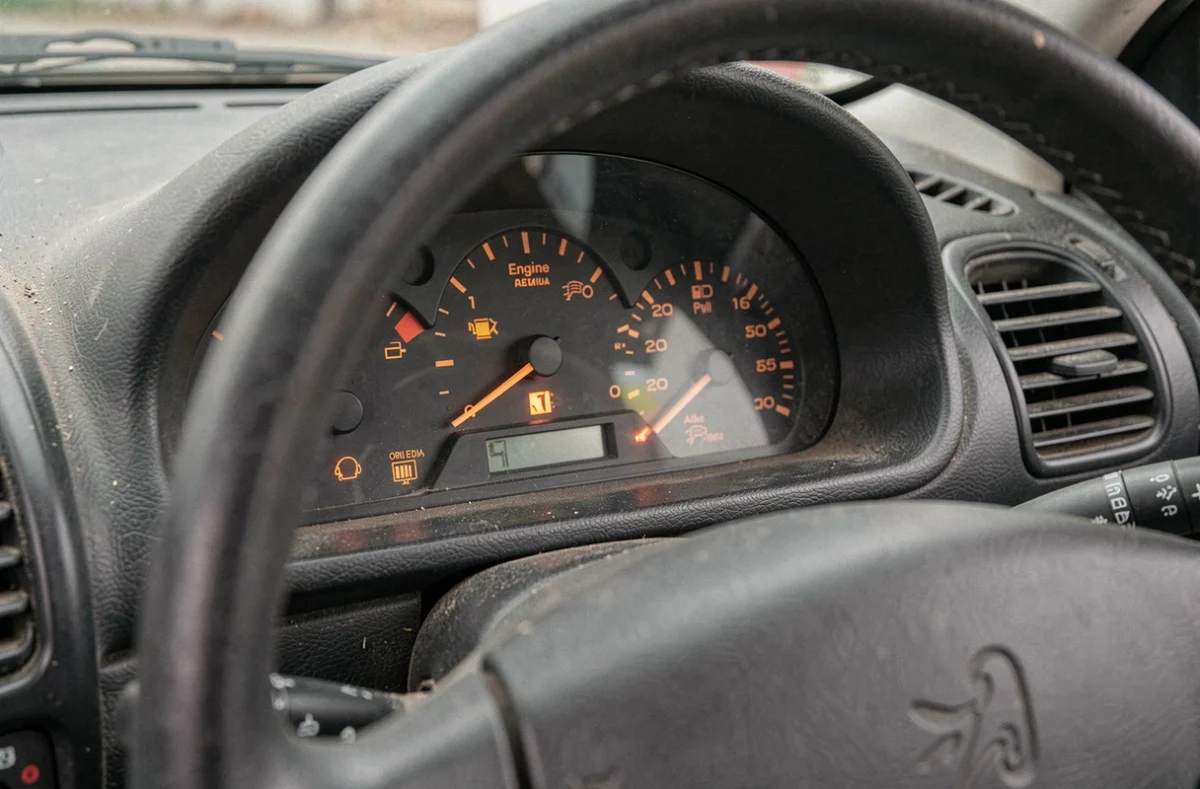
On the Peugeot 206, an orange warning light on the dashboard does not indicate a single fault. The same warning light can cover very different defects depending on the engine type (petrol or HDi), mileage, and maintenance history. Understanding the logic behind these alerts requires going beyond a simple color reading to delve into the behavior of the light and the systems it monitors.
Fixed or flashing engine light on Peugeot 206: two distinct diagnostics
The orange engine light on the 206 (symbol shaped like a stylized engine block) encompasses the scope of engine management and emissions control. We observe in the workshop that most drivers treat this light as a uniform signal, while its behavior radically changes the severity of the fault.
A fixed engine light indicates a fault stored by the computer. This could be a faulty lambda sensor, an out-of-tolerance boost pressure sensor, or a problem with the emissions control circuit. The vehicle is generally still usable, but the fault must be read with an OBD diagnostic tool to identify the exact code.
A flashing engine light signals a more immediate risk. On the 206, this flashing is associated with combustion misfires detected by the computer. These misfires send unburned fuel into the catalyst, which can cause overheating and irreversibly damage the catalytic converter. In this case, we recommend immediately reducing engine load and heading to a garage without delay.
To precisely identify the origin of an illuminated engine light, consulting a list of orange warning lights on Peugeot 206 detailing each symbol and associated actions allows for a quick sorting between minor alerts and faults requiring vehicle stoppage.

EGR and engine light on 206 HDi: a specific field use case
On the HDi diesel engines of the 206, the illumination of the orange engine light is often related to a clogged EGR valve. This problem is distinct from generic engine management faults and deserves separate treatment.
The EGR valve (Exhaust Gas Recirculation) reintroduces some exhaust gases into the intake to reduce NOx emissions. On HDi engines primarily used in the city (short trips, low RPM), the valve accumulates soot and carbon deposits that eventually seize the mechanism or block the flap in either the open or closed position.
The associated symptoms are characteristic:
- Progressive loss of power, especially during hard acceleration from low RPM
- Engine stuttering at stabilized RPM, sometimes accompanied by black smoke from the exhaust
- Illumination of the orange engine light, with a fault code related to the EGR circuit during diagnosis
- In advanced cases, the engine enters limp mode with RPM limitation
This issue does not concern the petrol versions of the 206. Cleaning or replacing the EGR valve generally resolves the problem, but the fault will reappear if the usage conditions remain exclusively urban. Regular highway trips help limit clogging by maintaining higher exhaust temperatures.
Orange triangle on Peugeot 206: a generic warning light often misinterpreted
The orange triangle (sometimes accompanied by an exclamation point) is the most misleading warning light on the 206’s dashboard. Unlike the engine light, which targets a specific scope, the orange triangle is a generic indicator that can correspond to several systems.
This light may illuminate to signal a brake fluid level issue, an anti-lock system fault, an anomaly detected by the electronic management system, or a tire pressure problem on equipped versions. Without a diagnostic tool to read the fault codes from the computer, it is impossible to determine the exact cause from the light alone.
We find that this light regularly generates misinterpretations. A driver who associates the orange triangle with a minor issue may overlook a braking fault, while another may stop for a simple faulty sensor. The only reliable approach is to connect an OBD-II reader and retrieve the recorded codes.
Orange lights related to the braking system
On the 206, the ABS light (orange, enclosed in a circle) and the brake light (red or orange depending on the fault) signal distinct problems. A permanently illuminated ABS light indicates that the anti-lock system is disabled. Conventional braking remains functional, but the vehicle loses anti-lock assistance in emergency braking situations.
A clogged or damaged wheel speed sensor is the most common cause of this light on high-mileage 206s. Replacing the affected sensor, identified through diagnosis, is usually sufficient to extinguish the warning light.

OBD diagnosis and orange lights: why color alone is not enough
The logic behind the orange lights on the 206 is based on a simple principle: to alert without requiring immediate stoppage, unlike red lights. In practice, this logic reaches its limits because the number of possible faults behind the same light far exceeds what a pictogram can communicate.
The computer of the 206 records standardized fault codes (DTC) accessible via the OBD-II port located under the dashboard on the driver’s side. An entry-level reader allows for reading these codes and guiding the diagnosis. Codes starting with P0 relate to engine and emissions faults, those starting with C0 pertain to the chassis (ABS, ESP), and B0 codes concern the body (airbags, lighting).
On a vehicle of this age, it is not uncommon to find multiple fault codes stored simultaneously, some of which correspond to isolated anomalies that have already been resolved. Clearing the codes and then monitoring their reappearance remains the most reliable method to isolate an active fault from residual history.
The technical inspection now penalizes certain warning lights illuminated on the dashboard. A permanent orange engine light may lead to a re-inspection, making a preventive diagnosis before the inspection center visit even more relevant.