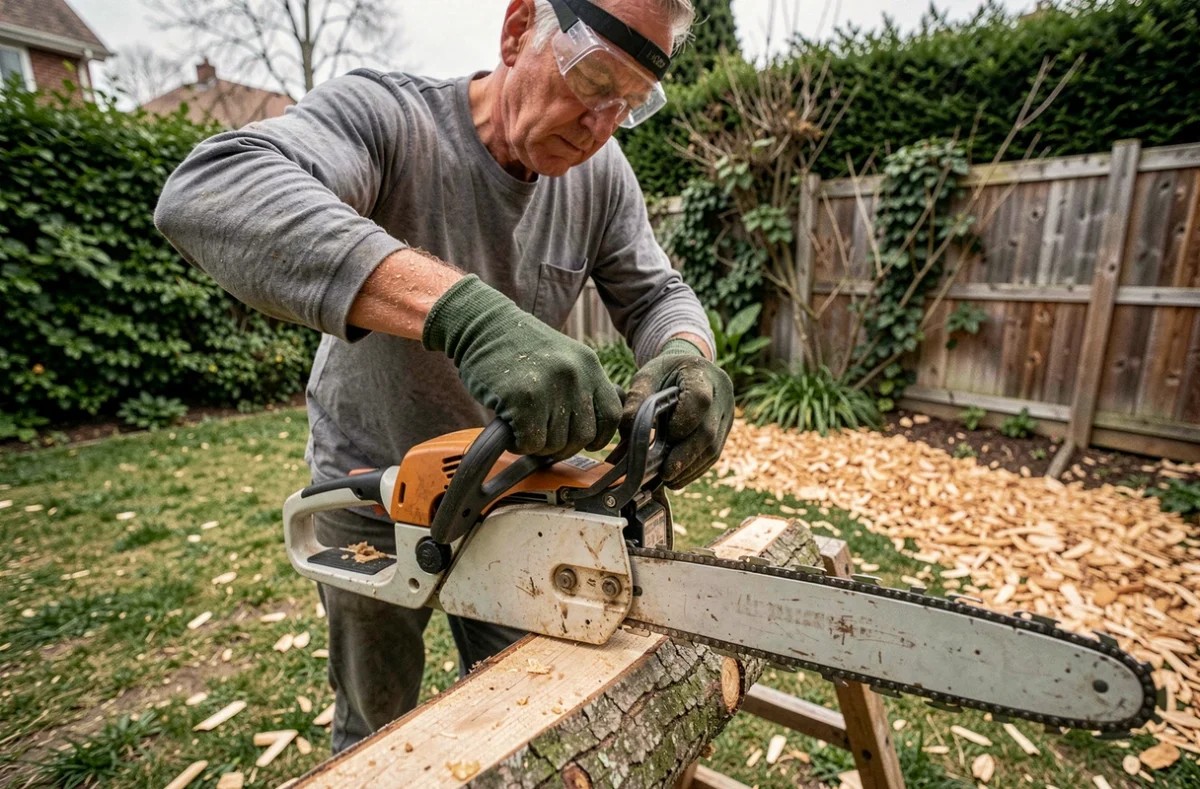
Cutting three large lime tree branches on a Saturday morning, bucking an ash tree that fell in a storm, preparing firewood a few metres from the house: that’s the Oregon CS1400’s natural habitat.
With 2400 W of power, a 40 cm bar and a weight of 5.9 kg, this corded electric chainsaw is designed for regular jobs near a power outlet. We took a closer look at what it does well, where it falls short, and, most importantly, the practical details product listings don’t mention.
Extension cords and voltage drop: the hidden pitfall of corded chainsaws
Plugging a 2400 W chainsaw into an indoor extension cord or a cable reel that hasn’t been fully unwound is a recipe for an overheating cable and a motor running at half power. The CS1400 comes with a very short power cord, so you’ll always need an outdoor extension cord.
To maintain the motor’s full power, you need a cable with the right cross-section for its length. The longer the extension cord, the thicker the cable needs to be; otherwise, you risk a voltage drop that reduces cutting performance. A cable reel must always be fully unwound: when coiled, the cable heats up, greatly increasing the risk of overheating.
This is no minor detail. With a powerful corded model like the Oregon CS1400 chainsaw, an incorrectly sized extension cord can cause the chain to slow down in hardwood, put extra strain on the motor and shorten its service life. Before comparing wattage, check your outdoor electrical setup.
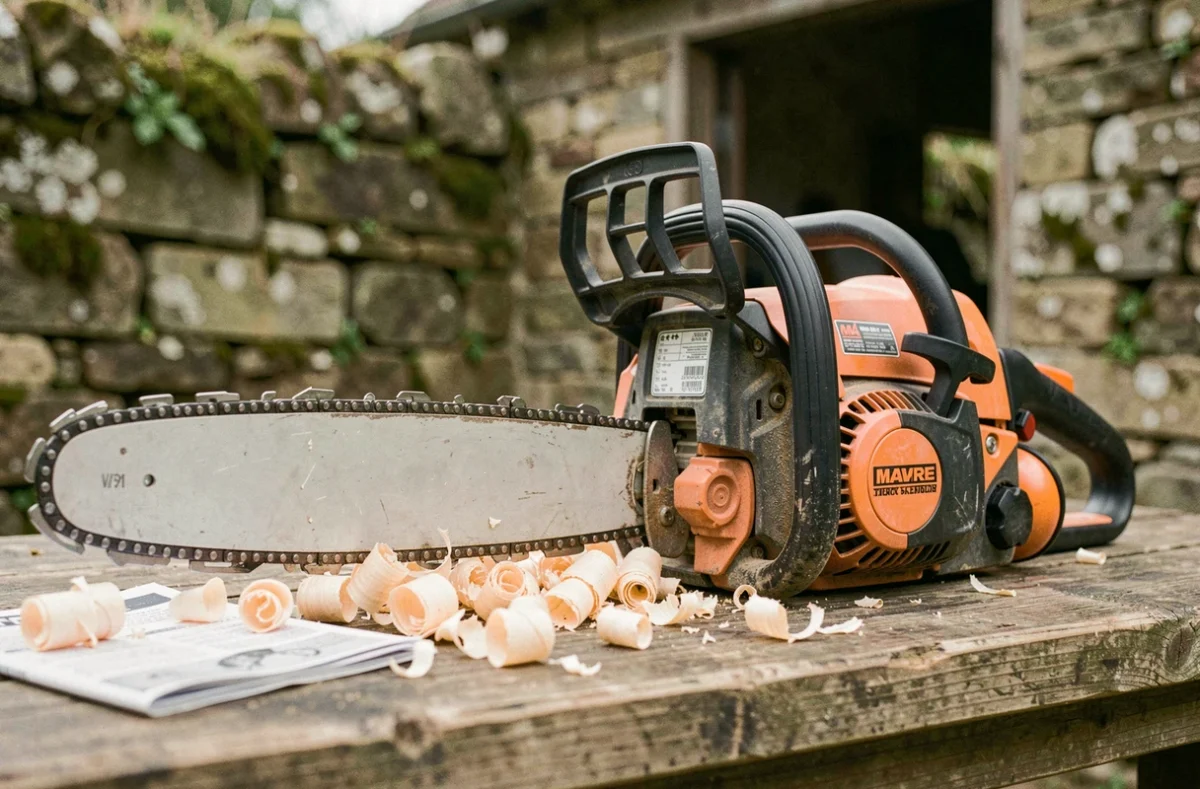
Oregon CS1400: real-world cutting capacity with a 40 cm bar
The 40 cm bar suggests a theoretical cutting capacity of the same diameter. In practice, you can comfortably cut logs and branches with a diameter slightly less than the bar’s length in a single pass. For anything larger, you’ll need to cut from both sides, making the job trickier and increasing the risk of the saw getting pinched.
With a chain speed of 14.7 m/s, it cuts cleanly and quickly through softwood such as poplar, fir and birch. Hardwood such as oak, beech and ash still cuts cleanly, but takes more patience. Oregon’s ControlCut chain stays sharp longer than a generic chain, which partly offsets the resistance of dense wood.
The chain’s main advantage is that it’s a standard type: no proprietary format and no locked-in consumables. You can replace it with any compatible 3/8″ LP chain with a 1.3 mm gauge, giving you more choice of suppliers and lowering maintenance costs over time.
Tool-free chain tensioning: a real time-saver
A chain loosening during a cut is fairly common, especially in hardwood. On the CS1400, the tool-free tensioning system lets you tighten the chain in seconds, without putting the saw down to look for a wrench. This small detail makes long cutting sessions run more smoothly.
CS1400 noise levels and local regulations: what to check
The Oregon CS1400 is noticeably quieter than a petrol chainsaw. You can hear the difference straight away. But “quieter” doesn’t mean “silent”, and certainly doesn’t mean “allowed at any time”.
In France, permitted hours for using powered garden tools are set by local or regional regulations. Allowed time slots vary from one municipality to another, particularly on Sundays and public holidays, when some local councils ban the use of all motorised tools outright. The fact that the CS1400 is electric does not exempt it from these rules.
French noise nuisance laws take into account the duration, frequency and intensity of the noise, not just its raw sound level. Before planning a major cutting session, check the rules posted at your local town hall or on your municipality’s website. You can still be fined for causing a noise disturbance, even with an electric tool.
Oregon CS1400 maintenance: three tasks to master
Without a petrol engine, there’s no fuel-and-oil mix, clogged air filter or spark plug to replace. Maintaining the CS1400 comes down to three recurring tasks:
- Check and top up the chain oil reservoir (140 ml) before each session. Automatic oiling protects the bar and chain, but only works when the reservoir is full. A poorly lubricated bar wears out two to three times faster.
- Tighten the chain as soon as it starts to slacken. The tool-free system makes this easy, but get into the habit of checking the tension while the chain is cold, before starting the saw.
- Sharpen the chain with a file when the saw starts producing fine sawdust instead of chips. Unlike the CS1500, the CS1400 has no built-in sharpening system, so you’ll need to use a round file by hand. This takes a little practice and a few minutes each time.
This is the CS1400’s main trade-off compared with its bigger sibling. If you’d rather not sharpen a chain yourself, the CS1500 with its built-in PowerSharp system may be a better fit, but it requires a proprietary chain and costs more to run in consumables.

Oregon CS1400: which gardeners is it for?
The CS1400 is a good fit for anyone who regularly cuts wood for heating, prunes trees or clears up after storms near a power supply, and is happy to sharpen the chain. Its 2400 W motor and standard ControlCut chain make it a reliable tool for softwood to moderately hard wood, within the reach of your extension cord.
It’s not the right choice if you regularly cut logs wider than the bar, work far from a power outlet or want to avoid all manual chain maintenance. In those cases, a battery-powered or petrol chainsaw may be a better option, despite their own limitations.
The CS1400’s value for money comes down to its simplicity: a powerful motor, an easy-to-replace standard chain and minimal maintenance. For a gardener with a good extension cord and a round file, it’s a straightforward tool that gets the job done.