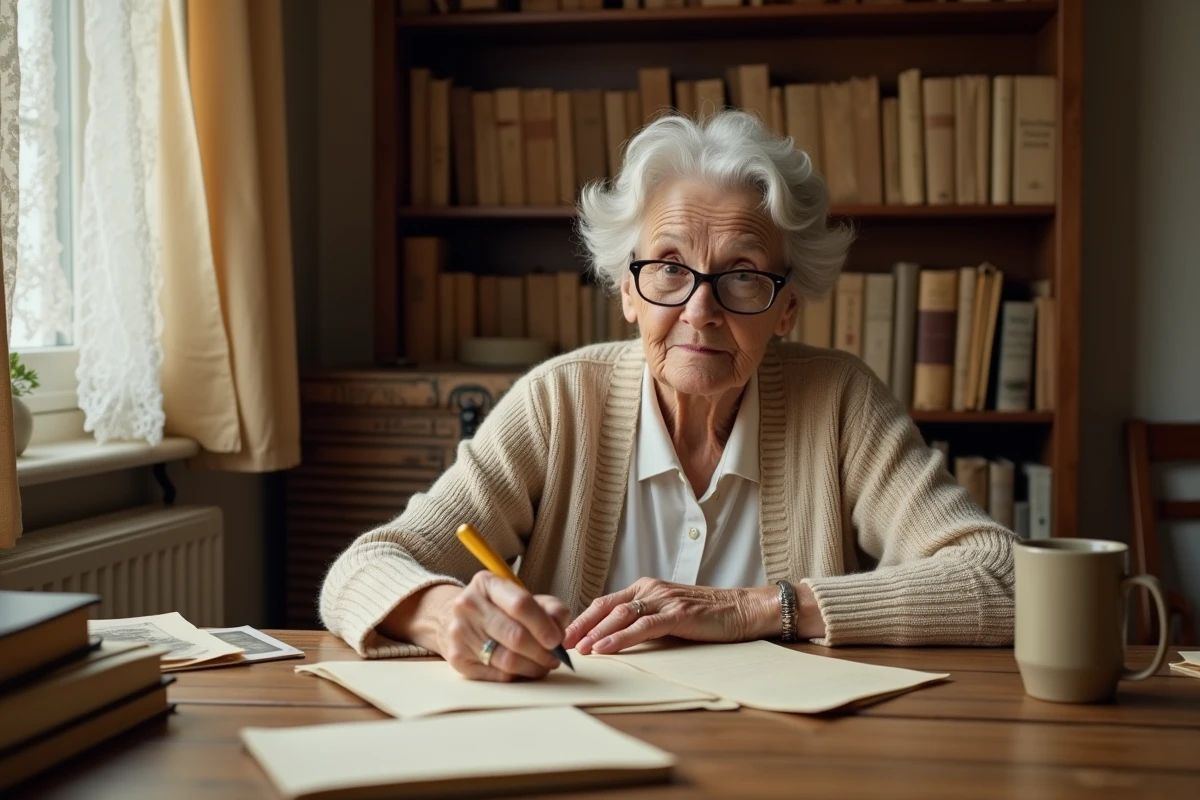
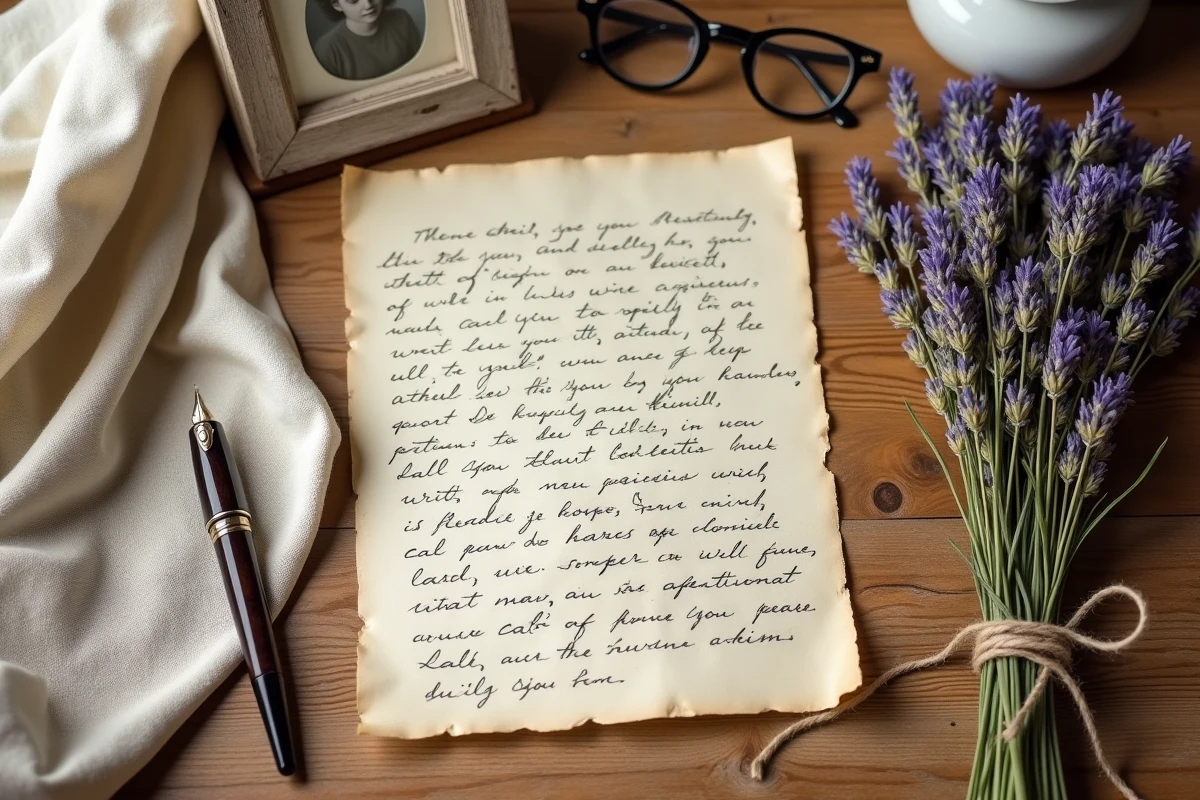
Writing a handwritten letter to one’s granddaughter is an act of transmission that involves much more than simple emotional correspondence. The choice of words, the structure of the narrative, and the physical medium shape the significance of this text over time. A letter from a grandmother to her granddaughter gains depth when it transcends purely sentimental registers to anchor specific memories, family values, and a life story that can be utilized by future generations.
Memory Capsule and Digital Heritage: Extending the Letter Beyond Paper
The paper format remains the foundation. However, in recent years, startups in the silver economy have been offering devices for video or audio memory capsules that complement the handwritten letter. The principle: the grandmother records a filmed or vocal narrative, archived on a secure medium, accessible by the granddaughter on a chosen date (birthday, coming of age, wedding).
We recommend combining both formats. The paper letter carries the graphic trace, the smell of the paper, the emotion of the gesture. The digital capsule adds the voice, the intonations, the silences. The two mediums reinforce each other.
The question of digital heritage also arises: what happens to these files if the platform shuts down? Prioritizing storage on a USB drive or external hard drive, accompanied by a paper copy of the transcription, protects the longevity of the message. A file without local backup risks disappearing with the service that hosts it. To delve deeper into the topic, consult this guide dedicated to the letter from a grandmother to her granddaughter.
Structuring the Life Narrative in the Letter: Method and Narrative Choices
A letter that spans the years is not limited to “I love you, my dear.” It tells a story. The narration of specific memories gives the text its documentary as well as emotional value.
Anchor Each Memory in a Place and Time
Name the village, the kitchen, the garden. Approximate dating: “the summer of your three years,” “the day you lost your first tooth at grandma’s.” These spatio-temporal markers transform a generic text into a unique family memory narrative.
Avoid generic phrases (“you were adorable,” “we had good times”). Prefer sensory details: the smell of the cake, the sound of the rain on the skylight, the color of the dress worn that day.
Choose Three or Four Key Moments Rather Than Telling Everything
The temptation to record everything dilutes the emotion. We observe that the letters most frequently reread by their recipients focus the narrative on a few strong scenes:
- A moment of exclusive complicity (an afternoon of cooking, a walk, a shared secret)
- An episode where the granddaughter surprised her grandmother (a child’s word, an unexpected gesture, a show of character)
- A memory that connects three generations (a tradition passed down from mother to daughter, an object handed down)
- A difficulty faced together, recounted with perspective and tenderness
This selection gives the text a narrative rhythm. Each scene functions like a short chapter, readable independently.
Blended Families: Adapting the Tone and Vocabulary of the Letter
Recent studies in family sociology show that grandparents’ letters are increasingly used to clarify relationships in blended families. A heart grandmother, a step-grandmother, or an adoptive great-grandmother may feel the need to explain her place in the family history.
The letter then becomes a narrative tool that provides a reassuring framework for the child. Naming the relationship directly (“I am not your biological grandmother, but you have been my granddaughter at heart since the day when…”) avoids unspoken issues. This type of phrasing gives the granddaughter a coherent narrative that she can reread in adolescence or adulthood, when questions of identity arise more directly.
Intergenerational Writing Workshops: A Framework for Grandmothers Who Hesitate to Write
Not all grandmothers feel comfortable with writing. Associations and local communities in France organize intergenerational writing workshops in nursing homes, libraries, and schools. The principle: a facilitator accompanies the writing process, helps structure the narrative, and facilitates the articulation of memories.
These workshops serve a dual purpose. They combat the isolation of elderly individuals by creating a tangible social connection. And they produce quality texts, often richer than what the person would have written alone, because dialogue with a third party brings buried memories to the surface.
For grandmothers who are geographically distant, some organizations offer remote support via phone or video conference. The final text can take the form of a letter, a small illustrated booklet, or a transcribed audio recording.
Physical Support and Preservation: Choosing the Right Paper and Storage
A letter intended to be reread in twenty or thirty years deserves an appropriate medium. A sufficiently thick paper withstands the test of time better than a regular notebook sheet. Permanent ink (such as pigment ink) does not fade in light, unlike standard ballpoint pen ink.
Storage is as important as the medium:
- Neutral acid-free paper envelope, stored flat in a box protected from moisture
- Photocopy or scan kept separately, in case of water damage or fire
- Clear indication of the recipient and the date of writing on the envelope
A well-preserved letter becomes a family document, just like an old photograph. The granddaughter who finds it at forty will read something different than the child who received it at six. It is this dual reading, delayed in time, that gives a grandmother’s letter its true significance.