
The average men’s shoe size is often summarized as a simple number, typically between 41 and 42 in France. This reference, repeated on most retail websites, serves as the basis for standardized size charts. However, it masks a more complex reality: shoe size depends on the country, age, foot morphology, and the measurement system used. Before ordering a pair online, understanding what this average entails can help avoid costly mistakes.
Average men’s shoe size: a number that varies by country and measurement method
International compilations of average shoe sizes show significant discrepancies from one country to another. These data are most often based on sizes sold, not on direct foot measurements. The distinction is far from trivial: the sizes sold reflect commercial availability as much as actual foot morphology.
A man in the Netherlands does not buy the same shoe size as a man in Japan, and the difference often exceeds two to three sizes. Measurement systems further complicate the picture. The Paris point (used in France), the UK system, and the US system do not segment sizes in the same way. A French size 42 roughly corresponds to an 8 UK or a 9 US, but these equivalences remain approximate depending on the manufacturers.
To learn everything about the average men’s shoe size, it is important to keep in mind that this number is a statistical convention, not an individual purchase recommendation.
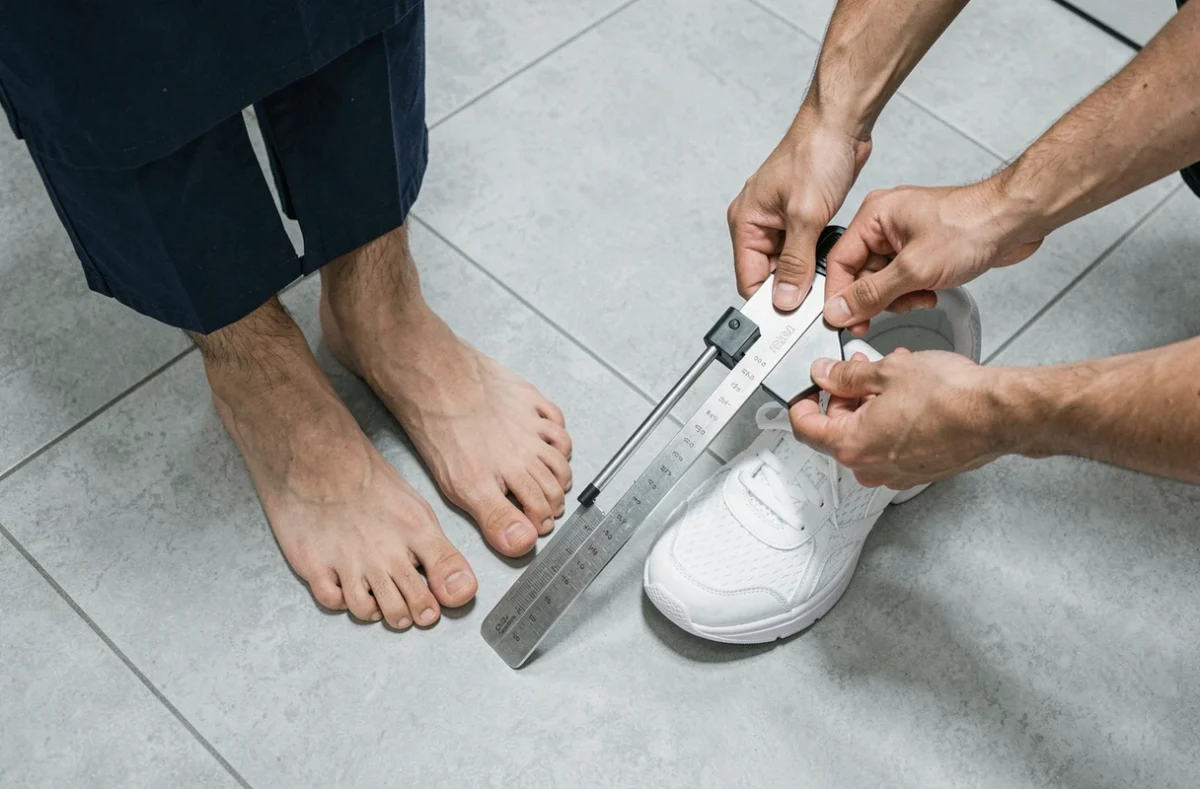
Foot width and aging: two parameters overlooked by size charts
The length of the foot is not enough to determine the correct shoe size. Width, often absent from online product sheets, plays a crucial role in the comfort and fit of the shoe. In Anglo-Saxon systems, the letter D denotes a standard men’s width, while E, 2E, 4E, and 6E correspond to progressively wider volumes. This coding varies from one manufacturer to another, which necessitates consulting each brand’s guide.
Age is another underestimated factor. The gradual collapse of the arch can widen the foot and sometimes slightly lengthen it. A person may retain the same theoretical size but need a wider fit or an additional half size after several years. This phenomenon has nothing to do with bone growth: it is a relaxation of the ligamentous structures.
Field reports differ on the extent of this change. Some podiatrists report half-size changes over a decade, while others observe more marked modifications in patients who have gained weight or engaged in intense physical activity.
Why a size 43 fits differently from one brand to another
For the same foot measured at 27.3 cm, manufacturers may recommend a 43, a 43.5, a 44, or a 44.5 depending on the internal length and shape of their model. This is not a failure of standardization: it is the direct consequence of different design choices.
Each brand builds its shoes around a last, which determines the internal volume, arch curve, forefoot width, and instep height. Two pairs labeled 43 can offer radically different internal spaces. The available data do not allow for a reliable universal size chart between brands.
Criteria to check before buying online
- The internal length of the insole (in cm), when indicated, is more reliable than the displayed size for comparing two models from different brands.
- The available width: check if the manufacturer offers multiple widths or a single fit, often calibrated to a standard D width.
- Customer feedback mentioning “fits large” or “fits small” provides a practical clue, provided it is corroborated across multiple reviews.
- The return policy: for a first purchase from an unknown brand, ordering two adjacent sizes remains the safest method.

Sports shoes, leather, boots: size also varies by shoe type
The type of shoe alters the needs for internal space. A hiking shoe requires extra room at the front to allow the foot to move forward when descending and to expand under effort. Simply increasing the size does not solve the problem if the forefoot remains too narrow.
A leather shoe, on the other hand, stretches slightly over time. Taking a half size up to anticipate this stretching often leads to a fit that is too loose after a few weeks. Sneakers, built on more generous shapes, generally fit larger than derbies or loafers of equivalent size.
How to measure your foot at home
The method remains simple but requires a minimum of precision:
- Place your foot flat on a sheet of paper at the end of the day (when the foot is at its maximum volume), and mark the end of the heel and the longest toe.
- Measure the distance in centimeters between the two marks, then repeat the process for the other foot – the two feet almost never have exactly the same length.
- Keep the measurement of the longer foot and refer to the brand’s size chart, not a generic chart.
The average men’s shoe size remains a useful statistical indicator for manufacturers calibrating their stocks. For the buyer, it does not replace the precise measurement of their own feet or the consultation of the specific size guide for the desired model. The most reliable reference remains the internal length in centimeters, cross-referenced with foot width and the type of shoe targeted.